What *would* Football 2.0 look like?
There are, as Benjamin Franklin said, only two certainties in life: death, and young'uns not having the attention span for long-form.
'Demise at the hands of an ambivalent generation' is an idea that keeps captivating people, even if it remains hard to see in practice. Folks have been worrying about 90-minute matches as long as I can remember and, if anything, (with attempts to quell time-wasting) matches are longer.
I guess that Doomsday cults do have a long lineage, although as part of a younger generation I'd prefer to see The End Of Days on a shorter time horizon.
This post has two non-footballing elements to thank for its existence: the Winter Olympics, and a question asked by host Richard Gillis on a cricketing Unofficial Partner podcast episode:
One of the questions for Ireland in the noughties was always 'how do they become a Test cricket nation?'. And I'm just wondering if that's still the goal, and whether or not that conversation has passed and Twenty20 is actually 'the thing'.
The Olympics is a little like a catch-all equivalent to T20 for other sports. There's a short-form, vertical video feeling to the Games; a collection of quick championships, generally in sports that people don't think about outside of the four-year cycle. Many sports want in. They wanna be in the Olympics feed. They wanna give people an introduction to their sport which lasts eight days rather than eight months of a year.
The cricket story of the past couple of decades, which Gillis is referencing, is how the sport managed to generate mainstream success with a format lasting four hours instead of five days. And also through India, and now non-Indian investors, really really loving the IPL (like, way more than other T20 competitions).
Football doesn't have either of these levers to play with. The matches are short. It already has a quadrennial festival. (The men's World Cup is surely the closest thing to a rival that the summer Olympic Games has).
What the football Doomsday heads really want - other than increased investment from an untapped global economy or two - is ice hockey.
Sign up for the newsletter to get blog posts when they come out
Now, the rink design is not pretty, especially compared to the clean lines of a football pitch, but evolution only selects for aesthetics when the beauty has a function. Restarts take place with face-offs, offside is a matter of attacking players crossing a line before the puck, the 'crease' (patch of blue ice) protects goalies (a little) from being thwacked.
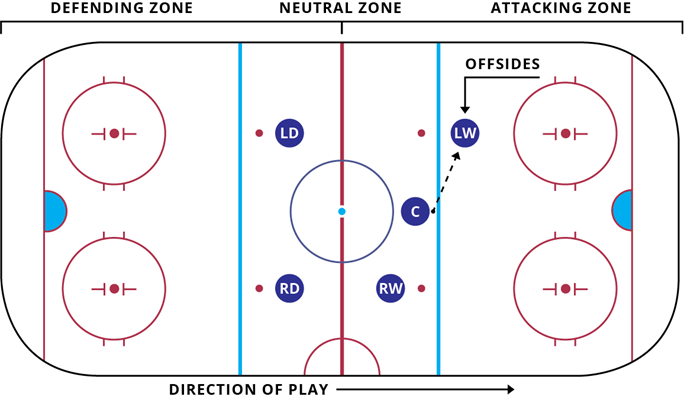
Then there's 'icing', an offence where a team clears the puck from their defensive zone and past the opposing goal line without it being touched. That brings play right back to the face-off spot in the defending team's zone. In football-speak, it seems to incentivise playing out from the back and high pressing.
Most of the 'invasion sports' that I sorta know (football, rugby, American football, ice hockey) have rules that compress the play in part of the field. Rugby disallows forwards passes; gridiron only allows one; football and ice hockey allow them but prevent players hanging out by the opposition's goal. Basketball's back-court rules have a similar effect, without anything being 'offside'. We'll return to that later.
If modern football feels a little dull it's not quite because the sport has become 'decompressed'. If anything, fitness and out-of-possession organisation has made it more compressed; gone are the days when teams would struggle to recover their shape after a turnover for entire minutes. But play is compressed into uninteresting areas. Tactical design, rather than game design, has pinned players into the middle third.
This is where we go back to basketball. The back-court rules disallow a team to return to their own half after entering the opposition's, but there's also a rule forcing them out of their own half within a time period. Netball, which actually forces players to occupy the full length of the court, creates the space for players (who aren't allowed to travel with the ball) to pass end-to-end freely.
Each sport, in their own way, tinkers with the rules to improve the conditions for action and drama.
Even, going back to the IPL, Twenty20 cricket. It took a long time for the modern version of the format to emerge; going via the 50-over one-day format, which itself tinkered with powerplays (periods where fielding rules are altered - particularly at the start of an innings, when the ball is newest and fastest, to encourage batting teams to take risks).
Experimenting with a sport's rules isn't easy, of course (although if we're looking for a grander purpose for the English League Cup, there we go). Fortunately, there are other vehicles for action and drama. And the Winter Olympics was full of it.
Before the Games even began, we had ski jump crotch chat, and things smoothly slid into Scandi infidelity chat, Minions copyright arguments, Lindsey Vonn's ACL tear and (we now know) near-leg-amputation-causing injuries. And it kept going: Nazgul the wolfdog, a more usual type of Olympics crotch chat (condom shortage), and the figure skating coach with no shortage of jackets.
A more sensitive organising body might clamp down on how much that potentially embarrassing stories like these are discussed. And yes, you wouldn't want most of these to become a pattern, but never in my life have I seen people talking about biathlon and figure skating so much.
Sign up for the newsletter to get blog posts when they come out
If a sport isn't a part of a cultural fabric, people don't pay to watch it and advertise around it, and athletes can't train to be good at it. (Unfortunately, sport's success being so wrapped up in the cultural fabric butts up against parts of The Culture being hostile to people in the sport). This interwoven existence with the cultural fabric was touched on by Maggie Murphy, Aston Villa Women's managing director, speaking recently to The Athletic.
“[With the most regular kick-off slot being midday Sunday,] Then you’re asking talent [at pre-match activations] to perform at 10.30 in the morning ahead of a 12pm kick-off. Kids and their parents have Sunday morning football. We’re trying to work with the universities, but university students coming out here at 10.30 on a Sunday morning? Probably not. So who are we going for? Mates that want to get together for a beer? At 10:30 in the morning?"
And rugby and TikTok star Ilona Maher, on the Richer Lives podcast:
What I really love about the WNBA is these players have really stepped up who they are, to create a brand off the pitch [...] I get kind of annoyed with rugby. We're not a sport that's going to get attention just by somebody tuning in. We're not the NBA or NFL, we need to do more. [...] I wish more players were putting themselves out there. If you want the sport to grow we need that, because I cannot be the only one that people come to the games to see.
Arguably, Maher has the Gerard Piqué-backed King's League as evidence in her corner too. You would think that a venture with a World Cup winner at its centre, that gathered together famous streamers and famous contemporaries of Piqué, would be a smash hit. And don't get me wrong, the numbers seem fine. Its recent 'Kings World Cup Nations' streams drew 200k-400k on YouTube and Twitch individually (while also being streamed elsewhere) prior to the final, which was obviously much more watched and had a full stadium attendance. Its Spanish and Mexican 'domestic leagues' are reportedly profitable.
Kings League is aimed at being Of The Culture, where the culture in question is teens and 20-somethings who watch streamers on Twitch. That does mean that, outside of the showpiece events, it is not an in-person spectator sport. As a 'digital native' venture, it's not designed to be, although one wonders whether that's a face-saving decision as much as anything, despite its easy-mode levels of famous backing. The WSL's in-person attendances this season have been discussed and fretted over, but they would dwarf Kings League attendance. (To be very clear, not an apples-to-apples comparison, but comparing apples and oranges isn't totally unfair).
Culture is difficult to define. It might even be harder to quantify than defending. At least with defending, you don't have to wade through the fake data of bot armies. (Even if there are data providers whose reliability feels like that).
If anyone in football gets it, it's Arsenal. Partly, this is an excuse to link the Adidas Originals 1990 advert from 2020. But they're also the powerhouse leader in women's football attendances, despite relative lack of recent success. (Relative both to Chelsea's six league titles on the bounce, and to Arsenal's own dominance of English women's football in the '90s and '00s).
Arsenal are cool. Their on-pitch product is meatwall corners (men's team) and bizarre third-gear performances (women's team), and yet they are still quite cool.
Football is such a hegemonic sport that it doesn't need to be too worried about losing its status (and if it really cares about The Youth, it might wanna make it easier for them financially). But if it's really worried about being disrupted, there are so many tweaks you could make that are aimed at fun and action (instead of at auditing in-match admin and time-keeping).
'Death at the hands of an ambivalent generation' only happens if you let them be ambivalent. Maybe the tweaks to keep things entertaining are the taxes you pay to keep them engaged.
Sign up for the newsletter to get blog posts when they come out